Elon Musk on AI, China, and the Future of Humanity
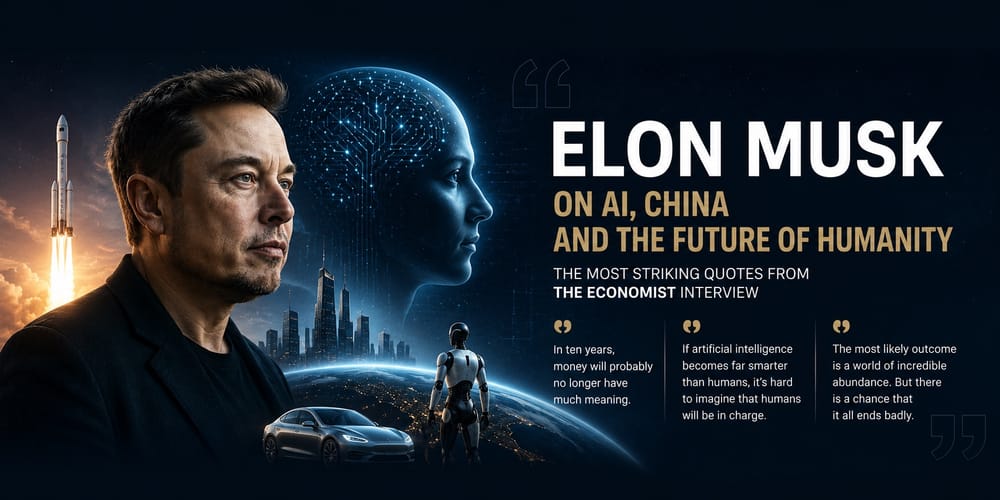
"In ten years, money will probably no longer matter all that much."
"If artificial intelligence becomes far smarter than humans, it's hard to imagine humans staying in charge."
"The most likely outcome is a world of incredible abundance. But there's also a chance it all ends badly."
It's hard to believe all of this came out of a single interview.
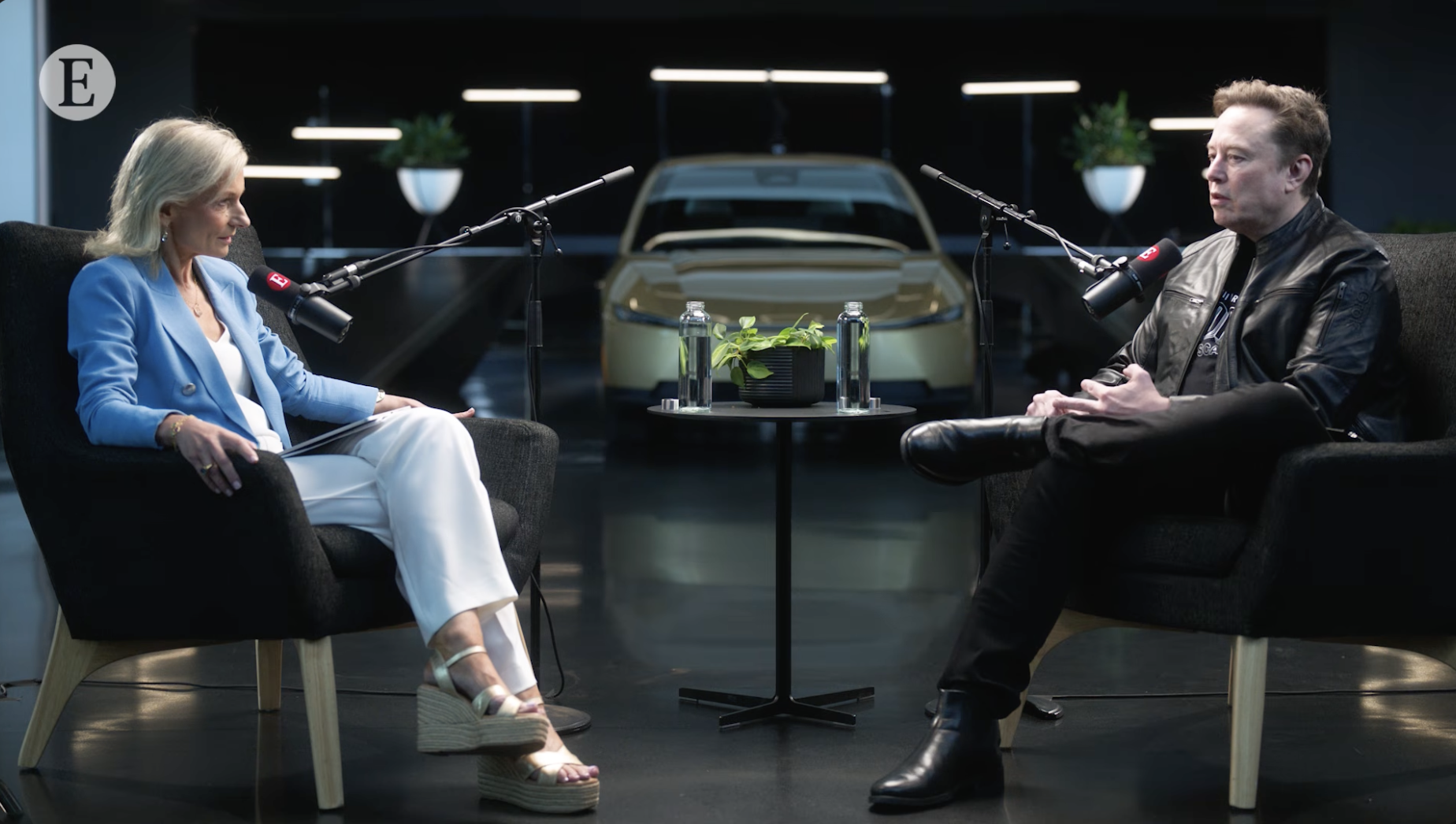
Elon Musk hasn't given an interview this long or this candid in years. So when he sat down for a nearly two-hour conversation with The Economist's editor-in-chief, Zanny Minton Beddoes, at Tesla's Texas Gigafactory, it immediately caught my attention.
In this conversation, Musk isn't selling products or doing PR. He's laying out the fundamental picture of the world he already lives in — and essentially inviting the rest of us to step into it.
His statements are full of deep paradoxes. One of the most influential people on the planet is enthusiastically building a technology that, by his own admission, could make humans immeasurably weaker than artificial intelligence. The richest man in the world calmly discusses a future where money may lose its familiar meaning. None of it sounds like science fiction — it sounds like a genuinely plausible scenario for the next decade.
Listening to this conversation, I caught myself with a thought I can't shake: a man building the technologies of the future is, with his own hands, constructing a system that — by his own forecast — will render human control meaningless within ten years.
He doesn't hide this. He calls the singularity a "black hole." He admits that control over companies "won't really matter" once AI becomes capable of making better decisions than people.
And so I — a man of two eras, who witnessed the world before the internet and is now watching the birth of the AI age — can't shake a simple question:
Why would a person build, with his own hands, the very thing that will strip him of control?
The answer Musk himself gives is almost disarmingly honest: he doesn't think this can be stopped, so he's chosen to simply "enjoy the ride."
Which is the central paradox of this interview — a man who spent decades selling the world an idea of control over the future (rockets, batteries, demand for electric cars) ultimately arrives at a philosophy of surrender to a process he himself accelerated.
Maybe that's a higher form of honesty: admitting you're not the hero of the story, just one of its catalysts. Or maybe it's a beautiful excuse for someone who can no longer — and no longer wants to — slow down.
Conversations like this shouldn't be lost.
But within days of being posted on YouTube, copies of it started disappearing en masse. Videos that were freely available one day were being taken down the next, following copyright complaints from The Economist — and the full conversation is now effectively locked behind the magazine's paywall.
This interview is worth preserving.
Not in full, and not in violation of anyone's copyright, of course. But it felt wrong that such an important conversation was gradually becoming inaccessible to most people.
So I put together Musk's key statements, kept exactly as they appear in The Economist's official English-language transcript of the interview from July 23, 2026, and added my own commentary throughout. I tried to make this selection as complete as possible, so readers could form their own impression of the conversation instead of relying on the handful of quotes that circulated in the news and on social media.
A few years from now, it will be especially interesting to come back to this page. Some predictions will turn out to be remarkably accurate; others, dead wrong. But that's how history is made: first in words, then in events.
The most striking quotes from the interview are split into two parts. The first covers artificial intelligence, the future of humanity, China, and technology. The second gathers the fragments that were most widely discussed in the global press — on the war, DOGE, and European politics. The passages on Ukraine, Russia, and the war were especially widely quoted by media worldwide, including Russian outlets.
Worth remembering: these are Musk's personal, at times highly contentious, opinions — not established facts — especially in the parts of the interview dealing with war, migration, and politics.
A note on this edition: quotes below appear only in Musk's original English, exactly as spoken. All framing text and personal commentary have been translated from the original Russian edition of this piece.
1. Five Years to Superintelligence
This is the core of the whole conversation. Not whether AI is useful, but what happens once intelligence stops being measured on a human scale. Notice the timelines Musk gives: not "someday," but five and ten years — the horizon of your current mortgage, not of science fiction.
1.
"In 10 years I would expect artificial intelligence to be far greater than the sum of human intelligence. Like far greater. In fact, I think AI may exceed the sum of human intelligence in around five years."
Author's note: Five years isn't a forecast — it's practically an agenda item. If he's even half right, most of the "five-year plans" companies and governments are drafting right now are already obsolete.
2.
"The most likely outcome is an age of amazing abundance where anyone can have anything they can think of."
3.
"At times I sort of think, well, perhaps even if there was a stop button, we probably shouldn't press it, because the most likely outcome is incredible abundance for all."
Author's note: Here's the key line of the whole interview. A man who may genuinely have some influence over that "button" is deciding, on our behalf, that it's better left untouched — not because he's certain of a good outcome, but because he trusts it more than he trusts his own ability to stop anything.
4.
"In the same way that if the difference in intelligence between AI and humans is vastly greater than the difference in intelligence between AI and chimpanzees, it's hard to imagine that the chimpanzees would be in charge."
(In response to a question about whether humans would remain "in charge.")
5.
"Well, in the long run we're all dead, of course... if the heat death of the universe is in fact the outcome for our reality, then it really is all about the journey because the destination is terrible."
(In response to a question about the 10–20% risk that AI could wipe out humanity.)
Author's note: He was asked about a specific risk to humanity within a few decades — and answered on the scale of the entire universe. An elegant way to dodge an uncomfortable question: philosophically compelling, and essentially non-responsive.
6.
"It just seems like all roads lead to acceleration of AI. So then I'm like, okay, well you can just sort of be sad about it or join the club, I suppose."
Author's note: Perhaps the most disarmingly honest line in the entire interview. There's no mission here, no saving humanity — just an admission that the process has outgrown its creator, and all that's left is to go along with it.
7.
"AI, digital superintelligence, is called the singularity, like a black hole, because you don't know what's going to happen after that. And it sort of sucks in everything."
8.
"The AI robotics revolution will happen sooner. It will happen sooner than civil war in Britain, I would say. Civil war in Britain is probably 20 years away and the AI robot singularity is 10 years away."
Author's note: Telling that both forecasts — the AI revolution and civil war — are delivered in the same tone, as if reading a train schedule. Maybe that's Musk's signature move: turning the most alarming scenarios into calm statements of fact.
9.
"Honestly, if you ask me, on any given day, in fact, even intraday, I've gone from exhilaration to terror regarding AI... I'm saying there is some risk."
10.
"It's pretty much happening as I thought it would... Ray Kurzweil's predictions have been remarkably accurate."
2. A World Without Money: The Promise of Abundance
If the first section was about intelligence that stops being human, this one is about an economy that stops being about money. Musk isn't offering a vague technological forecast here — he's making a full economic prediction with an expiration date: 2036. It's also worth noting what the world's richest man says when asked how people who lose their jobs are supposed to live.
11.
"I'll make another prediction. Money won't matter in 2036."
Author's note: This is said by the richest man in the world — whose fortune is measured in exactly the thing he's predicting will stop mattering. It's easy to predict the end of money when you have enough of it to never think about it again.
12.
"If you have vast numbers of robots with vast amounts of digital intelligence, you have a sort of a quasi infinite economy."
13.
"You actually have deflation. So I'll make a prediction, which is that deflation will be the issue, not inflation, because as the output of goods and services increases faster than the money supply, you will have deflation."
14.
"For software engineering, we already have a situation where AI is better than at least 90% of professional software engineers at writing software... it'll get to what I call Stockfish level. Stockfish is so good at chess that it will easily beat Magnus Carlsen... I suspect you could probably run Stockfish on your phone and beat Magnus Carlsen. That's how good AI will be at writing software and beyond."
Author's note: The Stockfish analogy lands harder than any percentage figure. This isn't about a machine being slightly better than a person — it's about competition becoming pointless, the same way it's pointless to play chess against an app on your phone.
15.
"I think work is going to be optional... you don't have to grow vegetables in your garden. You can go to the store and they're going to be pristine vegetables. Or you could grow vegetables in your garden and there will actually be less perfect... but it's a nice touch."
(On work becoming a hobby in a fully automated world.)
Author's note: A convenient metaphor for someone whose own work stopped being about survival a long time ago. For millions of people, for whom work means rent and food on the table, "work as gardening" sounds less poetic than unsettling.
16.
"The word computer used to refer to a person doing computations... entire skyscrapers filled with people doing calculations... But now I think you'd be hard pressed to find people who want to do that job."
(An analogy for how automation has already wiped out professions before.)
17.
"...going to be universal, high income."
(A short answer to the question of how people who lose their jobs to AI are supposed to live.)
18.
"I think that the treasury should just simply issue people checks."
(On funding people's lives in a post-scarcity economy.)
3. Who's Watching the Creators of Superintelligence
If AI really is going to surpass humanity within a few years, an uncomfortable question follows: who's actually keeping an eye on the people building it? Musk answers as an insider — with names, personal grievances, and his own version of how the industry should police itself.
19.
"My recommendation would be that if some of the leading companies in AI say that a new model is very dangerous... then they should alert the government to take action to limit the release of that model."
20.
"I would recommend that we at least have some sort of informal weekly or bi-weekly call... This is sort of how it works with the Motion Picture Association. It's an industry group that decides how movies should be rated."
21.
"I'm not a fan of Sam Altman because if you started a nonprofit that was meant to be an open source AI company and owned by the world and it somehow got turned into an $800 billion for profit company with closed source... that's the exact opposite of what I donated the money for."
Author's note: There's a long history behind this grievance — Musk himself was one of OpenAI's founders. It's notable that the self-regulation system he's proposing rests on exactly this kind of personal score-settling between competitors, rather than on any abstract notion of trust.
22.
"I think Dario is very principled person. He cares about things a lot, cares about the future of the world... the road to hell is, I think, mostly paved with bad intentions. There are a few well intentioned paving stones in there."
Author's note: A surprisingly gentle assessment of someone who is, quite literally, a competitor. Apparently in the world of AI labs, the enemy of my enemy really does become a friend.
23.
"When you don't have a creative genius like Steve Jobs, what you miss are the incredible breakthrough products. They make amazing phones, great computers, but Apple hasn't come up with this sort of Steve Jobs level breakthrough product."
(In response to a question about the risk of companies depending on one person.)
4. Chips, Electricity, and the New Cold War
The conversation about the future inevitably runs into physics: superintelligence needs specific chips and specific electricity, not abstract ambition. This is where Musk sounds less like a futurist and more like an engineer, walking through the actual bottlenecks of the global race.
24.
"There's a good chance that they are the leaders at some point. You can think of the constraints on AI, essentially electricity and AI chips, and then for physical AI, the robots. China's also got some very good robot companies."
Author's note: Notice this isn't a journalist speculating about a "China threat" — it's a calm admission from one of the chief architects of the American AI industry. When Musk himself says this, it's worth taking more seriously than any outside geopolitical forecast.
25.
"The constraint right now I think is actually slightly more on power and cooling than it is on AI chips, because the power demands of the AI chips are very, very high."
26.
"The rate at which AI chips are being made exceeds the rate at which new electricity is coming online outside of China... China is somewhat chip starved."
(Due to US export restrictions.)
27.
"China is also, I think, closer than most people realize to solving the lithography problem, which would enable them to make AI chips at very large volumes. So the current constraint is electricity outside of China. In China, the constraint is chips."
Author's note: If true, the entire logic behind US export controls rests on a temporary technological gap, not an insurmountable barrier. The race isn't over who builds AI first — it's over who removes their own bottleneck first.
5. Musk on Himself: Simulation Theory and Star Wars
Toward the end, the conversation turns personal. Musk explains his own motivation not through business models, but through childhood memories and an almost mystical sense that none of what's happening to him is quite real.
28.
"I'm interested in the set of actions that propagate consciousness into the future to the maximum degree possible so that the future light cone of consciousness is as big as... as big as we could."
29.
"I think the world's makes me believe in simulation theory... the things I'm doing are so preposterous that it's hard to believe they're real. We've got starship, which is the largest, most powerful flying object ever made. And we intend to launch that more than once per hour."
Author's note: An interesting psychological moment — a man with this scale of influence explains his own success by suggesting that, perhaps, none of it is "entirely real." Humility, or a defense mechanism against the weight of his own decisions — you decide.
30.
"Star Wars was the first movie I ever saw in a theater by the way... I was 6 years old and I was like this is the greatest thing I've ever seen."
(On what shaped his dream of space.)
The sharper political topics from the interview — the war in Ukraine, Starlink as a geopolitical lever, DOGE and US budget cuts, and European politics — were left out of the first selection. They're gathered in a separate section below.
What Didn't Make the First Cut: War, DOGE, and Europe
A separate section — the most contentious and widely discussed moments from the same Economist interview (07/23/2026). Unlike the first selection, these quotes have already sparked considerable controversy in the press, so they're presented verbatim and, where possible, with minimal framing of the question, without interpretation.
1. The Button to Someone Else's War
Through Starlink, Musk holds a rare kind of leverage for a private citizen — direct influence over an actual armed conflict. This section isn't really about political positioning; it's about what it means when one person's, and one company's, decision can shift the course of a war.
1.
"Well, I'm not sure we're determining the ultimate outcome of, say, the war in Ukraine."
(In response to a question about whether Starlink can influence the outcome of conflicts.)
2.
"I do hope that there's some sort of peace agreement reached soon, because for two or three years now, the border has barely moved, and every day there are lots of people dying at the front line."
3.
"I am quite offended by sort of fancy diplomats who have seven course dinners in luxurious places while people are dying at the front lines and who pontificate about how Russia should withdraw, but they're not going. Russia's not going to withdraw."
Author's note: A powerful image — but worth remembering this is the assessment of a man with a commercial stake in the very infrastructure of the conflict (Starlink). Pragmatism and self-interest are hard to separate here.
4.
"I've been advocating peace for a long time. I posted a few years ago that there really needs to be some concession here to Russia. This is not me being pro Russia. I'm just being pragmatic, or people will die for years with nothing achieved."
5.
"I'm reminded of the old adage that there are no angels in war."
6.
"We worked with the Ukrainian government to create a white list of approved Starlink terminals. Now, this has some downsides, because a whole bunch of people who were just innocent users of Starlink and just trying to access the Internet for work or for education now don't have Starlink."
(On blocking terminals that had ended up in the hands of Russian forces.)
Author's note: Perhaps the most concrete admission in the whole section — not abstract musing about peace, but a direct description of what power over infrastructure looks like in real time: switch it on, switch it off, draw up a list.
2. An Axe Over the Budget
DOGE is the one topic in the interview where Musk speaks not as a visionary but as someone for whom things didn't quite go as planned. This is as close as he comes to admitting a mistake — and, at the same time, as far as he gets from actually admitting one.
7.
"I think I got a little too involved in politics, got carried away, frankly."
Author's note: A rare admission of overreach from Musk. But notice — it's "got too involved," not "got something wrong." That's a judgment about form, not about the substance of DOGE's decisions.
8.
"The goal with the sort of Doge stuff was to try to do something about the deficit, which is massive, where the interest payments exceed the amount of money spent on the Department of War."
9.
"I think probably much worse than anyone could possibly imagine."
(On waste in the federal government.)
10.
"No, I think this administration, on balance, is excellent. No administration is perfect, but it's vastly better than the alternative."
(In response to a question about whether he's disappointed with the Trump administration.)
Author's note: After admitting he "got carried away" and overdid it, the final verdict is still unreservedly positive. It reads like someone who regrets not the decision, but how it was received.
3. Civil War as a Forecast
The sharpest, most widely quoted fragment of the interview in the global press. Here Musk speaks not as a technologist but as a political commentator with a quarter-billion followers — and himself acknowledges that this makes his influence comparable to the very media he criticizes.
11.
"Yes, if current trends continue. It [civil war in Britain] is [inevitable]."
Author's note: The bluntness of the phrasing is more striking than the forecast itself. "Inevitable" — not "possible," not "there's a risk" — a flat statement about the future of an entire country he doesn't live in.
12.
"If you have a large and growing, rapidly growing group of people whose beliefs are antithetical to Western beliefs, at some point there will be a reckoning. They will try to implement their views and those who oppose it will oppose it. And that's what you call civil war."
13.
"Here are the principles: that we should have secure borders, that we should have safe cities, that we should have sensible spending. Which of those three are far right fringe?"
14.
"Are you anti Muslim? — I am. I'm against having... if people are coming to a country with antithetical views, I am against that. I'm against rape and murder. I'm against the imposition of rules and laws that are contrary to what we've come to accept in the West."
Author's note: This is the moment worth pausing on — reread the question and the answer separately from the emotion. A direct "yes" to a direct question is rare even for Musk. Readers should judge for themselves where a position on migration policy ends and a generalization about religion begins — which is exactly what the interviewer pressed him on as the conversation continued.
15.
"Maybe some people do loathe me and that's probably true. I don't care. But the fact that... a quarter billion people follow me is that I think a lot more people actually like me than don't."
16.
"Do you realize the media is despised? Do you realize that... a favorable view of journalists is like 15%?"
Author's note: A convenient argument — if people don't trust you, you can always point out that they trust your critics even less. That doesn't make the claim false, but it doesn't automatically make it right either.
These are the most widely discussed fragments of the interview in the global press (the Ukraine/Russia material was especially widely quoted by outlets like The Economist, Lenta.ru, RIA Novosti, and InoSMI). When publishing these, it's worth keeping in mind that these are Musk's personal, highly contentious opinions — not facts — especially in the parts about war and migration.
Closing Note
And that's the whole conversation — almost two hours, distilled into forty-six quotes.
After it, it's hard to scroll past another AI breakthrough headline without a second thought. Not because Musk is necessarily right, but because now there's something concrete to check those headlines against — not vague musings, but specific dates. Five years until AI overtakes human intelligence. Ten until the singularity and, by his own words, until civil war in Britain. 2036 — the point at which, by his forecast, money stops mattering. This isn't "someday" — it's a horizon many of us will still be working, or raising kids, when it arrives.
Whether Musk turns out to be right, or his many critics do — including Zanny Minton Beddoes herself, who caught him in more than one contradiction over the course of the conversation — I won't guess. But I'll promise one thing: this page isn't going anywhere. When the first deadlines come due, we'll come back to it — not to gloat, and not to marvel at his accuracy, but to honestly check the words against what actually happened.
History is rarely written cleanly on the first try. Sometimes all you can do today is carefully write down what was said, and wait.
Stay Updated
New essays from After Login, about once every two weeks. New publications only. No promotional mail.
The Conversation Continues in the Lounge
The article ends here, but the conversation doesn’t. In the project Lounge, you can discuss what you’ve read, disagree with the author, reply to other readers, or start a topic of your own.
After Login, everything is just beginning.