Sam Altman: We Built AI, but We Still Haven’t Figured Out How to Live With It
The OpenAI CEO on AI’s missing “iPhone moment,” human inertia, new forms of power, personal AI agents, and a world that is changing more slowly than the technology itself
On August 23, entrepreneur and Founders podcast host David Senra published a lengthy interview with Sam Altman, co-founder and CEO of OpenAI. The conversation runs for just over an hour and is titled Sam Altman on Building OpenAI & Betting on the Impossible.
Original interview:
Sam Altman on Building OpenAI & Betting on the Impossible — YouTube
Full transcript with timestamps:
Transcript & Key Moments
Formally, the conversation is about OpenAI, entrepreneurship, technological bets, and running a company. But strip away the business anecdotes and the memories of Y Combinator, and something much more interesting emerges: a fairly coherent picture of how Altman himself imagines the next phase of coexistence between humans and artificial intelligence.
And that picture is noticeably calmer than the familiar forecasts in which AI either saves humanity tomorrow or puts everyone out of work.
Altman is saying almost the opposite.
Technology is racing ahead.
Humans are not.
And right now, that is the biggest constraint of all.
The Man Who Built ChatGPT Still Uses a Computer Much the Way He Did Twenty Years Ago
One of the best moments in the interview begins almost like a confession.
David Senra asks Altman whether he ever realizes that AI already makes it possible to do certain kinds of work in a completely different way — and yet still finds himself doing them the old-fashioned way.
Altman’s answer: “One hundred percent.”
He says that for roughly twenty years, he has used a computer in much the same way. He switches between apps, copies information from one window to another, goes through email deciding what to answer, and keeps to-do lists.
And this is a man who has Codex at his disposal — a system capable of taking over a significant share of that routine.
Altman describes this as one of the strongest psychological contradictions in his own behavior: rationally, he understands perfectly well that there is a better way to work, yet somewhere inside him remains the deeply ingrained feeling that working means pressing the buttons yourself, clearing your inbox, and crossing things off a list.
It sounds like an amusing everyday detail.
In fact, it contains one of the central problems of AI today.
We have acquired a new technology, but we are trying to squeeze it into the interfaces and habits of the old world.
When automobiles first appeared, people spent years thinking of them as horseless carriages. Early websites resembled printed pages. Early smartphones were still essentially tiny phones with keyboards.
Something similar is happening with artificial intelligence.
We open ChatGPT in a separate window.
We ask a question.
We get an answer.
We copy it into another service.
Then we take control of the computer again.
And the man running OpenAI does more or less the same thing.
AI Hasn’t Had Its “iPhone Moment” Yet
From there, Altman moves to one of the most interesting ideas in the entire interview.
In his view, AI today is roughly where smartphones were before the first iPhone.
Phones could already access the internet. Mobile applications existed. So did email, browsers, Palm devices, BlackBerrys, and countless other products.
Most of the underlying technological components were already there.
What was missing was one thing: a product that would bring them together and fundamentally change the way people interacted with computing.
Then came the iPhone.
Altman believes AI has not yet had an equivalent moment.
The technological pieces already exist. But the “iPhone moment” that completely changes the way people interact with technology has not happened yet.
He explicitly describes the current situation as a product failure, rather than a failure of model capability.
That distinction matters.
For the past few years, the industry has been almost obsessed with one question: which model is smarter?
GPT, Gemini, Claude, Grok — benchmarks, test scores, parameter counts, context windows.
Altman is effectively saying that the next real breakthrough may not happen when one model gains a few more percentage points on some benchmark.
It will happen when someone discovers the right way to embed all this intelligence into everyday human life.
At that point, the traditional computer may genuinely begin to disappear — not physically, but conceptually.
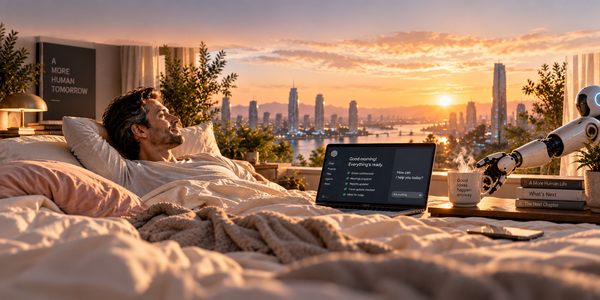
Instead of opening a program in order to perform a task, a person will tell the system what they want to accomplish, and the sequence of steps required to get there will become the machine’s problem.
We do not really have that kind of computer yet.
AI Is Developing Faster Than People Can Change Their Habits
Not long ago, many people in Silicon Valley assumed AI adoption inside companies would happen almost instantly.
It hasn’t.
Altman explains this in terms of human inertia.
People continue using familiar tools even when a clearly better alternative already exists.
He points to Netflix and Blockbuster: the new technology was more convenient, yet old behavior disappeared far more slowly than technology enthusiasts had expected.
And this is where his view differs noticeably from Elon Musk’s way of thinking about the future of AI.
I recently wrote a separate analysis of a major Elon Musk interview about the future of artificial intelligence — superintelligence, the singularity, the disappearance of conventional work, and the question of what role, if any, may remain for humans in that new world. If you missed it, I recommend taking a look at that piece as well: “title of the Musk article”. Comparing the two interviews is particularly revealing: Musk and Altman are talking about much the same future, but they are looking at it from very different directions.
For Musk, the development of artificial intelligence often looks almost like a physical process: computing power grows, intelligence accelerates, superintelligence becomes increasingly inevitable, and humanity moves toward technological singularity.
For Altman, there is another enormous layer between technology and the future:
human behavior.
A model may become twice as capable in a matter of months.
A human being may spend the same few months without even moving a familiar icon on the desktop.
These are two very different pictures of the same future.
For Musk, technology is the great accelerator of history.
For Altman, the greatest brake is still us.
And perhaps both are right at the same time.
Technology may move exponentially while society moves linearly.
If so, the true turning point will not come when the next more powerful model appears, but when those two curves finally intersect.
For the labor market, incidentally, that is good news.
If AI capabilities really do continue advancing this quickly, slow adoption gives society at least some time to adapt.
The Better AI Becomes, the More Valuable Humans May Become
Then the conversation unexpectedly turns from technology to people.
Senra poses a hypothetical: suppose artificial intelligence becomes capable of producing a brilliant podcast. Suppose two models can have a more interesting conversation than two humans.
Would people still prefer listening to human beings?
Altman says he deeply believes they would.
In his view, work rooted in human relationships, interest in other people, personality, and human connection could become more valuable, not less, in a world of increasingly capable AI.
That is far more interesting than the standard question of “which jobs will AI replace?”
Because the value of something does not come only from the quality of the output.
Imagine that AI one day really can write a better novel than the average writer.
Compose a better song than the average musician.
Make a beautiful film.
Conduct an excellent interview.
One question will still remain:
Who made it?
We are not interested only in Paul McCartney’s music. We are interested in Paul McCartney himself.
Not only in a Van Gogh painting, but in the human being who painted it.
Not only in the conversation, but in the people who sat across from one another.
And here, the difference between Altman and Musk becomes especially interesting.
Musk goes much further.
If artificial intelligence becomes more capable than humans in almost every field, if the production of goods and services becomes almost free, and the economy moves toward abundance, one question becomes unavoidable:
What function is left for humans at all?
In Musk’s picture of the future, this is one of the most unsettling questions.
Altman’s answer is almost the opposite.
He does not try to invent a new productive function for human beings.
He is effectively saying that perhaps human value does not have to come from being the most efficient producer of an outcome.
A machine may write better.
Draw better.
Program faster.
Analyze more data.
But people may still want to listen to another human being, look at something made by a human being, and talk to another human being.
These are fundamentally different ideas of value.
Musk asks: What will be left for humans to do?
Altman seems to answer: Perhaps the real question is not what humans will still do, but what they will still be.
And that may be one of the most important forks in the entire debate about artificial intelligence.
The more synthetic content fills the world around us, the more valuable a simple label may become:
made by a human.
So the common idea that AI will inevitably devalue human creativity may turn out to be too simplistic.
AI may devalue the production of content.
At the same time, it may increase the value of human authorship.
Two Risks: The Machine Escapes Our Control — or Someone Else Gains Too Much of It
When the conversation turns to AI safety, Altman identifies two fundamentally different risks.
The first is familiar.
We create an extraordinarily powerful system and eventually lose full control over it.
But Altman considers the second risk no less serious:
control remains — but becomes concentrated in the hands of a very small number of people.
A government.
A corporation.
The owner of the model.
A small group of people capable of deciding what information the system provides, which decisions it considers acceptable, and what behavior it permits for millions of users.
Altman strongly rejects the logic of “give us part of your freedom and we will guarantee your safety,” describing that kind of bargain as fundamentally anti-human.
Those are notable words from someone running one of the very companies that could potentially acquire that kind of power.
Which is precisely why some healthy skepticism is warranted.
Talking about decentralizing power sounds wonderful.
But as a handful of AI platforms increasingly become intermediaries between humans and information, the issue becomes very practical:
Who sets the boundaries of a model’s behavior?
Who decides what it shows?
What it hides?
What it prioritizes?
What it remembers about a user?
And will a user be able to take that accumulated digital context and move to another provider?
In the age of search engines, we at least chose where to go looking for information.
In a world of personal AI agents, the intermediary may be beside us all the time.
That is a profound difference.
And here Altman and Musk become surprisingly close.
Both are worried about concentrated power.
Both see extremely powerful AI as potentially dangerous.
But their emphasis is different.
Musk’s fear is aimed primarily forward — toward a system that could one day become so much more intelligent than humans that the idea of meaningful human control begins to collapse.
Much of Altman’s concern is aimed at the present — at the people controlling these systems today.
Those are two different scenarios for losing freedom.
In one, the machine begins making the decisions.
In the other, the machine remains a tool, but whoever owns the tool gains too much power over everyone else.
It is difficult to say which scenario is worse.
The second may even be more realistic, because it does not require us to wait for superintelligence.
It only requires a few AI systems to become the primary intermediaries between people and information.
And Yet Altman Is Much Calmer Than Musk
This is where the real break between the two men begins.
For years, Musk has spoken about artificial intelligence as a technology capable of bringing humanity to a point beyond which familiar methods of prediction no longer work.
Singularity.
Superintelligence.
An inability to know what comes next.
There is an almost existential anxiety in his vision of the future: we are building a system whose consequences we may be unable to imagine.
Altman sounds noticeably calmer in this new interview.
He argues that many of the catastrophic predictions of past years have so far failed to materialize, while the gradual release of increasingly capable models has allowed developers and society to learn from real-world experience and correct problems as they arise.
In his view, iterative deployment has produced more progress on safety than many expected.
It sounds reassuring.
But there is an interesting contradiction here.
Altman also acknowledges that we are approaching systems that could surpass even the smartest humans.
So his argument, in effect, becomes:
the gradual approach has worked so far — therefore we should hope it continues to work even when the nature of the technology itself changes.
Musk would probably object that this is exactly the point at which experience from the past stops being a reliable guide.
And here I would not rush to choose between them.
Altman is right about one thing: so far, the history of AI has been far less catastrophic than the darkest predictions of a decade ago.
Musk is right about another: the absence of catastrophe with systems at today’s level proves nothing about a world containing systems that are significantly more intelligent than humans.
They are not really arguing about today’s AI.
They are judging differently the point beyond which today’s rules stop applying.
A True Personal AI Must Know Almost Everything About Us
Another part of the interview sounds almost mundane, although its implications are much larger.
Altman says that today, the limiting factor is no longer only the intelligence of the model, but how little context it has about the user.
He wants AI to be able to see more.
For example, to read OpenAI’s internal Slack.
Study customer histories.
Read research papers he personally does not have time to get through.
Follow information relevant to his work.
And then use all of that when a decision needs to be made.
This is where we begin moving toward a true AI agent.
Not a chatbot that effectively starts over every time you begin a new conversation.
But a system that knows:
what you did yesterday;
what you are working on;
who you talk to;
which documents you have read;
what decisions you have made;
which mistakes you have made;
what matters to you;
what you promised to do;
what you are planning.
A human assistant physically cannot read tens of thousands of pages of your life in a few seconds.
A model can.
Altman believes this is where an entirely new way of working with AI may emerge.
And at the same time, this is where one of the biggest unresolved questions of the entire personal AI revolution begins.
To become genuinely useful, artificial intelligence has to know a person very well.
Perhaps better than any other person does.
But the more useful such an assistant becomes, the more personal information we have to entrust to it.
The exchange becomes rather striking:
we gain intelligence —
and pay for it with the context of our lives.
And once again, it is useful to compare Altman with Musk.
Musk tends to see AI primarily as an expanding external intelligence — a system that grows more powerful and may eventually surpass humanity.
Altman points toward another path: intelligence does not merely become stronger; it gradually grows into the life of the individual person.
One scenario leads toward superintelligence above us.
The other toward intelligence beside us.
But if a personal AI really does remember almost everything we have read, written, discussed, and decided, the line between those two scenarios becomes surprisingly thin.
Because a system that knows more about you than any human being and helps you make important decisions has a level of influence fundamentally different from that of an ordinary piece of software.
And here Musk’s old question about control suddenly returns in a much more everyday form:
Who is using whom — the human using AI, or AI using the human?
OpenAI Wants to Build a Platform, Not a Collection of Products
In the interview, Altman explains fairly clearly how he sees OpenAI itself.
Not as an app factory.
As a platform.
In his view, what users ultimately need is one interface to a personal or corporate AI capable of helping with virtually any task.
Developers, meanwhile, need an API on top of which they can build their own products.
The formula is remarkably simple:
one AI for the person + one API for everything else.
That also helps explain some fairly radical decisions inside OpenAI.
Altman says the company stepped away from independently developing Sora and the Atlas browser even though he considers both products good.
The reason is limited resources.
Compute.
People.
Time.
Rather than spreading those resources too thinly, OpenAI chose to focus on developing more general intelligence for knowledge work and, eventually, science.
That tells us more about the company’s strategy than another product launch would.
OpenAI does not want to build every application of the future itself.
It wants to sit underneath them.
Much as an operating system sits beneath applications, or an electric grid beneath household appliances.
If that strategy succeeds, OpenAI’s main business will not be convincing people to use a particular application.
The core product will be intelligence itself.
And That Intelligence Will Require Infrastructure on an Almost Civilizational Scale
Behind all the easy talk of personal assistants lies a much less romantic reality.
AI has to run somewhere.
Altman describes the expansion of computing infrastructure as potentially the most expensive infrastructure project in history.
Chips.
Semiconductor fabs.
Data centers.
Electricity.
Power grids.
Supply chains.
Financing.
Government policy.
That means the story of artificial intelligence is gradually ceasing to be merely a story about software.
It is becoming a story about industry.
Energy.
Capital.
And geopolitics.
For a digital assistant to answer instantly on a phone screen, somewhere there must be buildings the size of industrial complexes consuming very real electricity.
AI looks weightless only on the screen.
Behind the screen, it is becoming one of the most physical projects of the twenty-first century.
A Small Company May Have the Capabilities of a Large One
Against that backdrop, Altman makes another prediction: AI could trigger the largest boom in small business creation in history.
The logic is straightforward.
In the past, building a serious company required a team.
Programmers.
Designers.
Analysts.
Marketers.
Lawyers.
Support staff.
Finance specialists.
Now AI systems can gradually take over parts of those functions.
That does not mean one person will build the next Apple tomorrow.
But the size of the team required to create a product of a certain scale is clearly shrinking.
Altman expects a sharp rise in the number of small companies because of this effect.
And if that prediction proves correct, AI will change more than the labor market.
It will change the very idea of what a company is.
Ten years from now, we may be less surprised by a corporation employing one hundred thousand people than by a billion-dollar company run by twenty humans and several thousand AI agents.
Perhaps the Real Difference Between Musk and Altman Is Not Their Forecasts at All
Both believe the development of artificial intelligence is enormously important.
Both accept the possibility of intelligence exceeding human intelligence.
Both expect massive economic change.
Both worry about concentrated power and the loss of control.
The real difference may be where each of them is standing when he looks toward the future.
Musk looks at it like a physicist.
He sees an accelerating system and tries to extend the trajectory all the way to its logical limit.
If computing power keeps growing, models keep getting smarter, and automation keeps accelerating, then somewhere ahead lies a point after which human civilization becomes something fundamentally different.
Altman looks at the future more like an entrepreneur and product builder.
He is interested in the next step.
How do we make people use AI more naturally?
How do we give models more context?
How do we build the right interface?
How do we integrate agents into work?
How do we release increasingly capable systems gradually and observe what happens?
So Musk keeps asking:
“Where is all this going?”
Altman more often asks:
“What do we need to build next?”
And perhaps that is exactly why listening to them one after the other is so revealing.
One is trying to see the end of the road.
The other is busy building the next mile.
But the road, apparently, is the same.
But the Most Interesting Part of the Interview Is Not the Technology
After more than an hour of conversation, one strange impression remains.
The man running one of the world’s most important AI companies is not saying that artificial intelligence is currently being held back by a lack of intelligence.
Quite the opposite.
The technology is already capable enough to begin changing fundamental things.
But human beings are still living by the old rules.
We still clear our own inboxes.
Open applications.
Keep task lists.
Build companies around organizational structures inherited from the twentieth century.
Grow used to measuring work in hours spent in front of a screen.
And try to use artificial intelligence as just another application inside the familiar computer.
Perhaps that is exactly why Altman talks about AI’s missing “iPhone moment.”
The real revolution will not begin when the next model becomes twenty percent smarter than the previous one.
It will begin when we no longer have to think about how to use artificial intelligence.
We will simply say what we want.
And the system will know enough about us and about the world to work out the rest.
Which leads to a question far more interesting than the traditional “Will AI replace humans?”
If artificial intelligence can read more than we can, remember more than we can, analyze faster than we can, and perform most digital work on its own —
what, exactly, will still be our work?
Musk pushes that question almost to its limit: if machines can do practically everything better and more cheaply than humans, what function remains for human beings themselves?
Altman, surprisingly, offers a calmer and much more human answer.
Deciding what we want.
Choosing.
Building relationships.
Taking an interest in other people.
Creating meaning.
In other words, the more capable the machine becomes, the more important everything that once seemed too ordinary to count as a uniquely human ability may become.
And perhaps the real turning point is still ahead.
Only it will not be the moment when artificial intelligence finally becomes intelligent.
It already is intelligent enough.
It will be the moment when we finally learn how to live beside it.
After login, everything is only beginning.
Stay Updated
New essays from After Login, about once every two weeks. New publications only. No promotional mail.
The Conversation Continues in the Lounge
The article ends here, but the conversation doesn’t. In the project Lounge, you can discuss what you’ve read, disagree with the author, reply to other readers, or start a topic of your own.
After Login, everything is just beginning.